%20(1).png)
AI isn’t the first disruption photography has faced — and it won’t be the last. This article explores who AI will replace, who will survive, and why human vision, storytelling, and authorship still matter more than any tool.
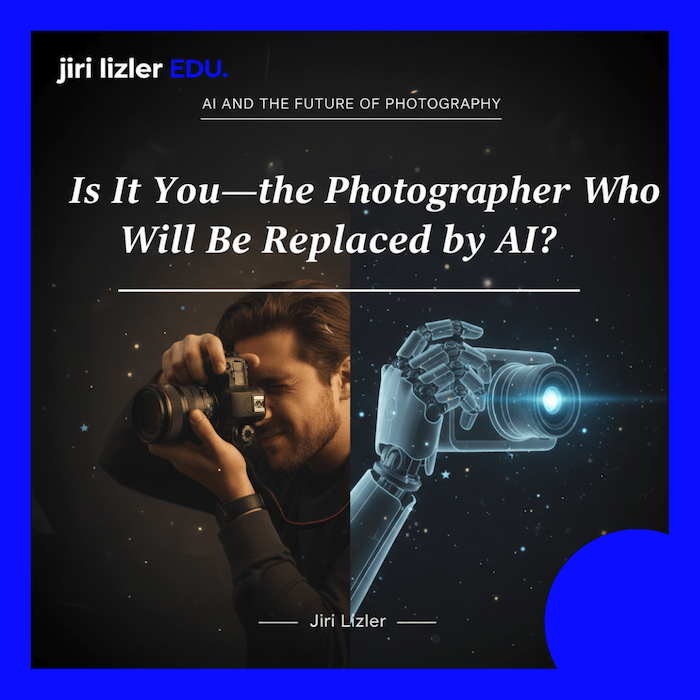

When people talk about artificial intelligence today, it sounds like the first real threat to the photography profession.
But it isn’t. We’ve been here before—several times.
In the 1990s, analog photographers feared that digital photography would destroy the craft.
“If anyone with a camera can take photos, who will need professionals?”
With hindsight, we know the opposite happened:
Digital photography did not mean the end of photography, but the beginning of a new era defined by speed, accessibility, and flexibility.
Around 2010, another wave of fear arrived: that 3D renders would replace product and architectural photographers.
And to some extent, it did. I still remember the uncertainty—questioning whether it made sense to keep photographing at all and how we would adapt. That was the moment when Jirka began learning 3D modeling, and we started thinking seriously about what the future might look like.
But the market didn’t collapse—it split:
Those who learned to collaborate with 3D designers often doubled their workload.
Those who closed themselves off gradually disappeared from the market.
Today’s AI is faster, more accessible, and astonishingly precise.
It’s not just a new tool—it’s an entirely new visual language.
Instead of lenses and sensors, it uses data.
Instead of light, it uses algorithms.
But the principle remains the same as always:
Every new technology replaces mechanical repetition—
never human vision and interpretation.
AI cannot physically press a shutter button.
But it can simulate the result of a photoshoot with remarkable accuracy—from lighting and composition to realistic skin textures.
Today’s tools can:
What does this mean?
A photographer whose business is based purely on technical camera operation and basic retouching is now competing directly with an algorithm.
And that algorithm doesn’t get tired, doesn’t make mistakes, doesn’t need light or weather—and keeps improving.
Estimates vary, but most experts agree:
within 5–10 years, generative AI will be so precise that the average viewer won’t be able to distinguish between real and synthetic photography.
Given what tools like Nano Banana, Evoto, and Photoshop already achieve, we suspect this shift may happen even faster.
In commercial fields—advertising, product photography, stock imagery—it is already happening.
Large agencies are replacing parts of production with AI-generated images: they’re cheaper, free of logistical issues, and infinitely adjustable to client demands.
Photography as a craft will not disappear—but it will change.
Just as it did with digital cameras and smartphones—only this time, the transformation is happening much faster.
AI can generate flawless product shots on clean backgrounds or in realistic environments.
Tools like Pebblely, Flair AI, or Kive.ai already allow brands to create product scenes without taking a single photograph.
For small e-shops, this is extremely appealing: no shoots, no props, no time investment.
AI can replace skies, add light, or even fully model interiors.
Clients increasingly request “visualizations” instead of real photographs.
With tools like Interior AI, REimagineHome, or RoomGPT, magazine-ready interiors can be created in minutes—without a camera.
Social media and commercial platforms are filling up with AI-generated models who don’t exist.
Companies use synthetic people in advertising to avoid licensing, usage rights, and casting.
Tools like Synthesia or Photo AI allow endlessly reusable, customizable characters.
Major fashion brands currently use AI mainly for concept development and layout design.
But early projects already exist where entire visual campaigns were created without a photoshoot.
With advanced photorealistic generation (Midjourney v6, Sora, Runway Gen-3), fashion visuals will soon become hybrids of photography and digital creation.
Photographers whose work is built on:
have a strong chance of enduring.
This includes:
AI can generate visually beautiful images—but it still cannot capture relationships, coincidence, atmosphere, or authenticity.
These are exactly the elements that make photography more than just an image.
AI may change how images are created.
But it won’t change humanity’s desire to capture the world, stories, emotions, and relationships.
Photography as storytelling will not disappear—it will move from the technical realm into the human, authorial, and experiential one.
👉 So the real question isn’t: “When will AI replace us?”
The real question is:
“What do I offer that no AI can create?”
If you have an answer—even a small, personal, imperfect one—
then you are exactly the kind of photographer who will survive every technological wave.